Bryan William Brickner
  • Blog
  • Interviews
  • Articles
  • Books
  • Photos and Video
  • Links

The Greek Solution: One’s Daimon and Arendt Footnotes #6

9/5/2015

0 Comments

 
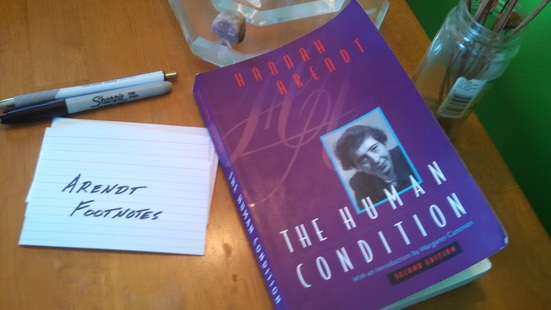
PictureArendt Footnotes #6, Eudaimonia
(AF6 - sixth in a series)


Eudaimonia

Arendt enlightens the misery of blindness to our own light.


The Human Condition
Section 27: The Greek Solution
(192-3, bold added)

This unpredictability of outcome is closely related to the revelatory character of action and speech, in which one discloses one’s self without ever either knowing himself or being able to calculate beforehand whom he reveals. The ancient saying that nobody can be called eudaimon before he is dead may point to the issue at stake, if we could hear its original meaning after two and a half thousand years of hackneyed repetition; not even its Latin translation, proverbial and trite already in Rome – nemo ante mortem beatus esse dici potest – conveys this meaning, although it may have inspired the practice of the Catholic Church to beatify her saints only after they have long been safely dead. For eudaimonia means neither happiness nor beatitude; it cannot be translated and perhaps cannot even be explained. It has the connotation of blessedness, but without any religious overtones, and it means literally something like the well-being of the daimon who accompanies each man throughout life, who is his distinct identity, but appears and is visible only to others. (footnote 18)

18. For this interpretation of daimon and eudaimonia, see Sophocles Oedipus Rex 1186 ff., especially the verses: Tis gar, tis aner pleon / tas eudaimonias pherei / e tosouton hoson dokein / kai doxant’ apoklinai (“For which, which man [can] bear more eudaimonia than he grasps from appearance and deflects in its appearance?”). It is against this inevitable distortion that the chorus asserts its own knowledge: these others see, they “have” Oedipus’ daimon before their eyes as an example; the misery of the mortals is their blindness toward their own daimon.

Have a good burn!

Next Up: Republic and the 228th birthday of the US Constitution, Thursday 17 September.

Posted by Bryan W. Brickner
0 Comments

Montesquieu’s Rapports and Human Passions: Burning Man Edition Arendt Footnotes #5

9/1/2015

0 Comments

 
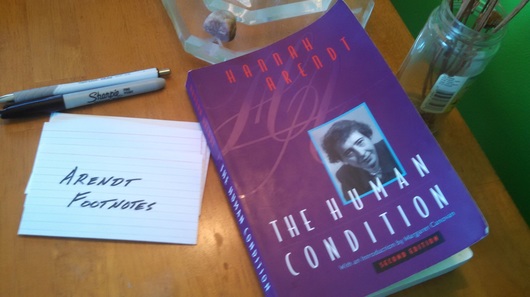
PictureArendt Footnotes #5, Boundary Onslaughts
(AF5 - fifth in a series)


Boundary Onslaughts

Arendt notes Montesquieu’s unique definition of laws: rapports subsisting between different beings. This is a stepping-stone footnote; it furthers a discussion of government before the onslaught of human affairs.

The Human Condition
Section 26: The Frailty of Human Affairs
(Page 190-1, bold added)

Action, moreover, no matter what its specific content, always establishes relationships and therefore has an inherent tendency to force open all limitations and cut across all boundaries. (footnote 17) Limitations and boundaries exist within the realm of human affairs, but they never offer a framework that can reliably withstand the onslaught with which each new generation must insert itself. The frailty of human institutions and laws and, generally, of all matters pertaining to men’s living together, arises from the human condition of natality [birth rate] and is quite independent of the frailty of human nature.

17. It is interesting to note that Montesquieu, whose concern was not with laws but with the actions their spirit would inspire, defines laws as rapports subsisting between different beings (Espirit des lois, Book I, ch. 1; cf. Book XXVI, ch.1). This definition is surprising because laws had always been defined in terms of boundaries and limitations. The reason for it is that Montesquieu was less interested in what he called the “nature of government” – whether it was a republic or a monarchy, for instance – than in its “principle … by which it is made to act, … the human passions which set it in motion” (Book III, ch. 1).

The Man burns in 4 days.
 
Next Up: Arendt Footnotes #6, The Greek Solution: The Daimon, Saturday 5 September.

Posted by Bryan W. Brickner
0 Comments

Popular Belief in the Strong Man: Burning Man Edition Arendt Footnotes #4

8/25/2015

0 Comments

 
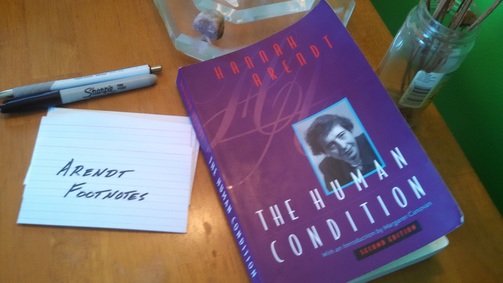
Picture
(AF4 ~ fourth in a series)


The Strong Man Fallacy

Hannah Arendt, who survived the “strong man” Adolph Hitler, notes that history is filled with examples of strong men become impotent; this is because they did not know how to enlist the help of the many.

The Human Condition
Section 26: The Frailty of Human Affairs
(Page 188, bold added)

Action, as distinguished from fabrication, is never possible in isolation; to be isolated is to be deprived of the capacity to act. Action and speech need the surrounding presence of others no less than fabrication needs the surrounding presence of nature for its material, and of a world in which to place the finished product. Fabrication is surrounded by and in constant contact with the world: action and speech are surrounded by and in constant contact with the web of the acts and words of other men. The popular belief in a “strong man” who, isolated against others, owes his strength to his being alone is either sheer superstition, based on the delusion that we can “make” something in the realm of human affairs – “make” institutions or laws, for instance, as we make tables and chairs, or make men “better” or “worse” (14) – or it is conscious despair of all action, political and non-political, coupled with the utopian hope that it may be possible to treat men as one treats other “material.” (15)

14. Plato already reproached Pericles because he did not “make the citizen better” and because the Athenians were even worse at the end of his career than before (Gorgias 515).

15. Recent political history is full of examples indicating that the term “human material” is no harmless metaphor, and the same is true for a whole host of modern scientific experiments in social engineering, biochemistry, brain surgery, etc., all of which tend to treat and change human material like other matter. This mechanistic approach is typical of the modern age; antiquity, when it pursued similar aims, was inclined to think of men in terms of savage animals who need be tamed and domesticated. The only possible achievement in either case is to kill man, not indeed necessarily as a living organism, but qua man.

The Man burns in 11 days.

Next Up: Arendt Footnotes #5, Montesquieu’s Rapports and Human Passions, Tuesday 1 September.

Posted by Bryan W. Brickner 
0 Comments

The Artist Objects: Burning Man Edition Arendt Footnotes #3

8/18/2015

0 Comments

 
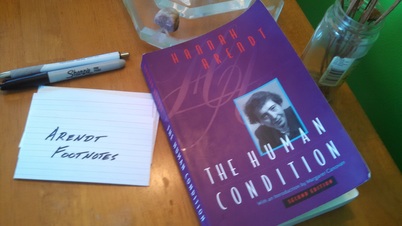
PictureArendt Footnotes #3 ~ The Artist Objects
(AF3 ~ third in a series)


The Artist Objects

The third to last paragraph in Hannah Arendt’s The Human Condition also contains the book’s final footnote; its focus is art and modern man:

(Page 323, bold added)
Needless to say, this does not mean that modern man has lost his capacities or is on the point of losing them. No matter what sociology, psychology, and anthropology will tell us about the “social animal,” men persist in making, fabricating, and building, although these faculties are more and more restricted to the abilities of the artist, so that the concomitant experiences of worldliness escape more and more the range of ordinary human experience. (footnote 87)

87. This inherent worldliness of the artist is of course not changed if a “non-objective art” replaces the representation of things; to mistake this “non-objectivity” for subjectivity, where the artist feels called upon to “express himself,” his subjective feelings, is the mark of charlatans, not of artists. The artist, whether painter or sculptor or poet or musician, produces worldly objects, and his reification has nothing in common with the highly questionable and, at any rate, wholly unartistic practice of expression. Expressionist art, but not abstract art, is a contradiction in terms.

The Man burns in 18 days.

Next Up: Arendt Footnotes #4 and The Popular Belief in a Strong Man, Tuesday 25 August.

Posted by Bryan W. Brickner

0 Comments

World War I: Willy-Nicky Were Willy-Nilly Emperors

7/18/2014

0 Comments

 
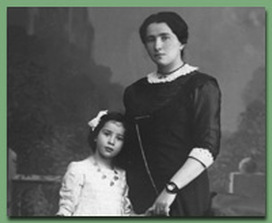
PictureHannah Arendt and her Mother (1912)


War Cry Heal Union: The series (4th of 10)


Empires crumble in willy-nilly ways.

That’s Hannah Arendt (1906-1975) and her mother in 1912. They are Jews in Kaiser Wilhelm’s German Empire ~ and Emperor “Willy” didn’t like Jews.

In Russia and cousin Tsar Nicholas’ empire, the world of Emperor “Nicky,” Jews weren’t liked much either. Examples: the 1891 Ukase (executive order) expelling 20,000 Jews from Moscow and the Russian language gave us the word pogrom ~ an organized, sanctioned and violent assault on a Jewish community.

In Germany the clearest example is Emperor Wilhem.  John Röhl, in The Kaiser and His Court: Wilhelm II and the Government of Germany (1994: p. 210), provides some choice 1919 anti-semitic Willy words. First, the former Emperor calls his abdication: “the deepest, most disgusting shame ever perpetrated by a person in history, the Germans have done to themselves... egged on and misled by the tribe of Judah ... Let no German ever forget this, nor rest until these parasites have been destroyed and exterminated from German soil!” Second, Willy praises Russia’s pogroms and, chillingly, said the Jews were a nuisance and should be gotten rid of; in 1919, the fallen German Emperor Kaiser Wilhelm even stated how: “I believe the best thing would be gas!”

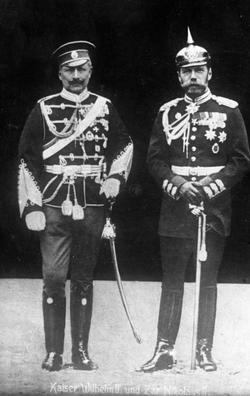
PictureKaiser Wilhelm ~ Tsar Nicholas (1905)
War cries.

From 28 July to 1 August 1914, the two Emperors exchanged telegrams with the intention of avoiding “bloodshed” ~ the Willy-Nicky Telegrams. The telegrams are ego-empiric (it is 1914 and Sigmund Freud is nearby in Vienna, Austria); they read nice at the beginning, both talking of peace and accommodation. In the end, on the eve of catastrophe, the letters expose the underlying insecurity and paranoia inherent to empire; Willy and Nicky boxed themselves into their hubristic minds, and in that state one never hears the cries of Others ~ emperor or Jew.

Willy and Nicky’s failure produced 15 million dead, the Soviet Union and Hitler's Third Reich (two more empires really), and sowed the harvest we call World War II. Kaiser Wilhelm abdicates in 1918 and is exiled to the Netherlands; he blames his “Hebrew subjects” and “the tribe of Judah” for his fall and writes Hitler congratulatory notes (on the 1939 invasion of Poland, for example). Tsar Nicholas’ fate is fatal: he abdicates in 1917, is imprisoned and then murdered on the orders of the new Others.

In October 1964, Gunter Gaus interviewed Hannah Arendt on “Zur Person” (The Person); the show was taped for a West German audience and she answers questions about heritage, growing up in Konigsberg and her mother’s influence. The interview highlights Arendt as a political theorist; when asked about 1933 Germany, the year the Nazis came into power, and what that was like, Arendt describes the motivating will of the Unrepresented ~ of the Other ~ that speaks in all ages: “Indifference was no longer possible in 1933. It was impossible even before that.”

Tomorrow on the War Cry Heal Union series ~ Civil War Battle Flags, Medals of Honor and Soldiers Unknown.
Posted by Bryan W. Brickner

0 Comments

World War I: Empires Crumble and Others Build

6/27/2014

0 Comments

 
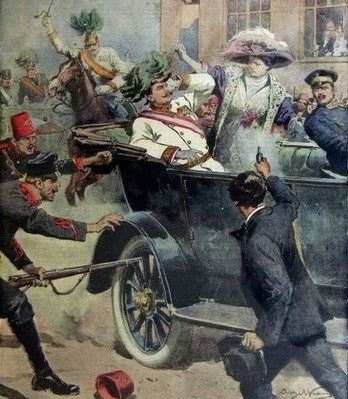
PictureSarajevo 28 June 1914


War Cry Heal Union: The series (3rd of 10)

The United States is the Other today: Hannah Arendt cast in lead.

The painting of the assassination on June 28th 1914 portrays the heir to the Austrian-Hungarian Empire, Archduke Franz Ferdinand, and his wife Sophie being shot by 19 year-old Gavrilo Princip on a Sarajevo street corner.

The painting encapsulates an era of endemic militancy that fueled 1914 Europe and the catastrophe called World War I: fired shots, stunned chauffer, blank-wall, sabered rider, plumed officer, soldiers sashed, lurched and rifled, and a grounded headless hat.

Those times and today’s circumstances are nicely summed in the Wall Street Journal article, Scars of World War I Linger in Europe on Eve of Centennial. The author notes war’s carnage is never simple (or just) and 15 million dead also means 15 million destroyed homes, families and relationships. Lyrically apropos war is not: it thrives and embellishes disharmonies in order to live off the discord. War needs Others, that is clear. One take home lesson for today is that Peace needs Others just as much (maybe more).

Hannah Arendt, who found citizenship in America, is today’s representative example of the Other. Born in 1906 in one of the Empires about to fall (the German one), Arendt “moved” to the United States running from the Nazis and their ideas of Otherness: Arendt became a US citizen.

Representative Arendt? ~ Yes, it has a nice sound to it.

Citizens like Hannah Arendt in Congress representing a district of thirty thousand as our constitution commands? That too sounds nice. Geez ~ she wrote The Origins of Totalitarianism (1951) and The Human Condition (1958), and would have added much to any mid-century policy debate.

Maybe that’s one of our political bad habits we can grow away from, this always thinking it can’t matter who’s representing us.

We will learn the constitutional lessons of representing We the People, or, like the generations before us, some will survive the carnage and do what the Others always do – start building again.

Peace Others.

Bryan W. Brickner
Ew Publishing


0 Comments

George Washington, John F. Kennedy and Hannah Arendt’s Constitutio Libertatis

2/16/2014

0 Comments

 
Picture
Hannah Arendt is (surprise) a constitutionalist. She wouldn’t mind the tag too much – others are Marxist and feminist – German and American: she was lots of things.

Arendt (1906-1975) was trained in Europe before World War II, working with the likes of Karl Jaspers, Martin Heidegger and Walter Benjamin. She fled Germany to France in 1933: the Germans wouldn’t let her teach in their universities because she was a Jew. When the Nazis took over France in 1939, she was interned in a camp and labeled an enemy alien; soon after she escaped, making her way to the United States and New York City in 1941. Arendt became an American citizen in 1950.

The tag of constitutionalist is from Arendt’s chapter four in On Revolution (1963), “Foundation I, Constitutio Libertatis” – meaning orders (regulations) and legal status.

The Latin phrase jumped out at me; at first I thought she might be saying something negative … then I read a bit of the chapter: one page really, page 142. Arendt notes the stages of rebellion and revolution are different by contrasting the historian to the political scientist; she argues the historian looks at “the violent stage of rebellion” while the political scientist looks to “the quieter stage of revolution and constitution.”

That caught my attention: she’s saying revolution by constitution is quiet. I had to read it again – here it is:

“If, however, one keeps in mind that the end of rebellion is liberation, while the end of revolution is the foundation of freedom, the political scientist will at least know how to avoid the pitfall of the historian who tends to place his emphasis upon the first and violent stage of the rebellion and liberation, on the uprising against tyranny, to the detriment of the quieter second stage of revolution and constitution, because all the dramatic aspects of his story seem to be contained in the first stage and, perhaps, also because the turmoil of liberation has so frequently defeated the revolution.”

Arendt argues the French Revolution (1789-99) failed because it lost its way; the American Revolution (1776-83), with its “fever of constitution-making,” highlights her idea of success:

“This temptation, which befalls the historian because he is a storyteller, is closely connected to the much more harmful theory that the constitutions and fever of constitution-making, far from expressing truly the revolutionary spirit of the country, were in fact due to forces of reaction and either defeated the revolution or prevented its full development, so that – logically enough – the Constitution of the United States, the true culmination of this revolutionary process, is understood as the actual result of counter-revolution.”

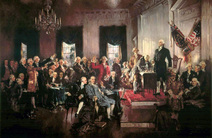
Arendt refers to the US Constitution as, “the true culmination of this revolutionary process.” She is not running for office – she’s theorizing:

“The basic misunderstanding lies in the failure to distinguish between liberation and freedom; there is nothing more futile than rebellion and liberation unless they are followed by the constitution of the newly won freedom.”

Constitution again … then Arendt finishes the paragraph by quoting a founder:

“For ‘neither morals, nor riches, nor discipline of armies, nor all these together will do without a constitution’ (John Adams).”

Arendt’s On Revolution was published in 1963, the year of President Kennedy’s assassination (a moment of violence); she wrote of his death for the New York Review of Books that December: The Fate of the Union: Kennedy and After.

Arendt was born into a monarchy, fled fascism, wrote of quiet revolution by constitution, and then lived through America’s turbulent 1960s. It’s no wonder Arendt was fond of America’s revolutionaries, men like George Washington and John Adams. She knew their faults. She also knew they understood Constitutio Libertatis and lived it – just like Hannah Arendt did.

Happy Presidents Day America ~ And Happy Birthday George!

Bryan W. Brickner
~
Hannah Arendt Movie Trailer (2013)

0 Comments
Forward>>

    Author

    Brickner has a 1997 political science doctorate from Purdue University, cofounded Illinois NORML in 2001, and was a 2007 National NORML Cannabis Advocate Awardee. He is also publisher and coauthor of the 2011 book banned by the Illinois Department of Corrections – The Cannabis Papers: A Citizen’s Guide to Cannabinoids.

    Archives

    November 2019
    October 2019
    September 2019
    July 2019
    June 2019
    May 2019
    April 2019
    March 2019
    February 2019
    January 2019
    December 2018
    November 2018
    October 2018
    September 2018
    August 2018
    July 2018
    June 2018
    April 2018
    March 2018
    February 2018
    December 2017
    November 2017
    October 2017
    September 2017
    August 2017
    July 2017
    June 2017
    May 2017
    April 2017
    March 2017
    February 2017
    January 2017
    December 2016
    November 2016
    October 2016
    September 2016
    August 2016
    July 2016
    June 2016
    May 2016
    April 2016
    March 2016
    February 2016
    January 2016
    December 2015
    November 2015
    October 2015
    September 2015
    August 2015
    June 2015
    May 2015
    April 2015
    March 2015
    February 2015
    January 2015
    December 2014
    November 2014
    October 2014
    September 2014
    August 2014
    July 2014
    June 2014
    May 2014
    April 2014
    March 2014
    February 2014
    January 2014
    December 2013
    November 2013
    October 2013
    September 2013
    July 2013
    June 2013
    April 2013
    January 2013
    October 2012

    Categories

    All
    17 September
    22nd Amendment
    2 AG
    2-AG
    435
    502nd Infantry
    5 HT
    5-HT
    5-HT
    5 HTP
    5-HTP
    7th Amendment
    9 April 1792
    Aborigine
    A Cabal
    Acetylcholine
    Adam Smith
    Aesop
    Aging
    Akhil Reed Amar
    Albert Hoffman
    Alcohol
    Alexander Hamilton
    Alexander R. Boteler
    Alice In Wonderland
    Alzheimer's/Dementia
    Ambrose Burnside
    American Revolution
    Anandamide
    Andrew Leitch
    Antietam/Sharpsburg
    Anti Republic
    Anti-Republic
    Anti-Semitism
    Archie Lieberman
    Art
    Artemis
    Article The First
    Aspasia Of Miletus
    Athena
    Augustus Kotka
    Bastogne
    Benjamin F. Cheatham
    Benjamin Franklin
    Bivalency
    Black Hawk War 1832
    Brain Gut Axis
    Brain-gut Axis
    Bringing It Home
    Burning Man
    California
    Cancer
    Candide
    Cannabinoids
    Cannabinoid System
    Cannabis
    Carcinogenesis
    Caryophyllene
    Caudate Putamen
    Cb1
    Cb2
    CB2 GPR55 Heteromers
    CB2-GPR55 Heteromers
    CBD
    Cheatham Hill
    Chicago
    Circulatory System
    Cluster Headache
    CNS
    Colitis
    Comrades
    Confederate
    Conservative-Liberal (CL)
    Constitutio Libertatis
    Constitution
    Daimon
    Daniel Morgan
    David Bradford
    David Redick
    Depression
    Despotism
    DHA
    Didaskalos
    Digestive System
    Domestic Tranquility
    Donald Trump
    Dopamine System
    Douglas Southall Freeman
    Dubuque
    Earth Day
    Eisenhower
    Elbridge Gerry
    Electoral College
    Emperor Napoleon
    Endocrine System
    Enumeration
    EPA
    Epilepsy
    Er
    Estrogen
    Exercise
    Ex Falso Quodlibet
    FAKE News
    Federalist 57
    Florida
    Fort Sumter
    Founders
    Francis P. Blair
    Freedom
    Free Markets Cannabis Act (FMCA)
    French Revolution
    GABA
    Gallant Fourteenth
    Georges Danton
    George Thomas
    George Washington
    Georg Groddeck
    Gettysburg
    Gideon
    Gliomas
    Glutamate
    Goddesses
    Government Grown
    Gpr55
    Graham Greene
    Hannah Arendt
    Harlem Heights
    Headache
    Hedonism
    Hemp
    Henry Knox
    Henry Kyd Douglas
    Henry Lee III
    Herbaceutical
    Herbiceutical
    Heteromers
    Hillary Clinton
    Homeostasis
    Horatio Gates
    Hot-flash-reduction
    Hypothalamic-neurohypophyseal
    Ice
    Illinois
    Immigrants
    Immune System
    Indiana
    Indiana 99th Regiment
    Indole-quinuclidine-analogs
    Inflammation
    Irritable Bowel Syndrome Ibs
    It
    Jack-herer
    James Monroe
    James Rumsey
    James W. Foley
    James Wilkinson
    Jean Baudrillard
    Jefferson Davis
    Jesus
    Jim-champion
    Joe
    Johann Palm
    John Adams
    John Bunyan
    John Finley Pettigrew
    John F Kennedy
    John-jay
    John Locke
    John Mosby
    Johnny Reb
    John Roberts
    Jonathan Magbie
    Kaiser Wilhelm
    Keith Marker
    Knowbody
    Kynurenine
    Lil Man
    Liminal
    Lincoln
    Lipids
    Louis Armstrong
    LSS
    Lt
    Lysergic Acid Diethylamide Lsd
    Madison
    March-madness
    Marijuana
    Martin Luther
    Maximilien Robespierre
    Melanocortin Circuit
    'Mericans
    Michigan
    Microbiota
    Migraine
    Mitochondria
    Molly Role
    Monroe Doctrine
    Montesquieu
    Morphine
    Mt-vernon
    Muggles
    Multiple-sclerosis
    Nabiximols-sativex
    Nazis
    Nemesis
    New York
    Nietzsche
    North Carolina
    Nowhere
    Nuclear Receptors
    Obama
    Obesity
    Ohio
    Once Upon A Time
    Opioid
    Otto Snow
    Pain Relief
    Paraquat
    Parmenides
    Parthenongenesis
    Patrick-henry
    Paula Lind Ayers
    Peace Terms
    Pediatric
    Pericles
    Philadelphia
    Phototherapy
    Physiodelia
    Physiology System
    Pituitary-stalk
    Plato
    Pot
    Pregnancy
    President Taylor
    Psilocybin
    PTSD
    Publius
    Puritans
    Putin
    Quakers
    Race
    Ra Chaka
    Ralph Waldo Emerson
    R. Bruce Dold
    Representation
    Reproductive System
    Republic
    Respiratory-system
    Richard Lee I
    Rick Simpson
    Robert Dahl
    Robert E. Lee
    Roman Republic
    Sarah Tonin
    Sarajevo
    Secession
    Serotonin System
    Shall
    Shivitti
    Silent Night
    Skeletal System
    Slavery
    Sleep
    Snake And Turkey
    Socrates
    Sophie Scholl
    Sophocles
    South Carolina
    Sperm
    Spermatogenesis
    Spermatozoa
    Sport
    Star Of David
    Stephen Young
    Suicidal
    Sun Tzu
    Sweat
    Tell Lie Vision
    Tell-Lie-Vision
    Texas
    THC
    The Boys
    The Cannabis Papers
    The Federalist Papers
    The-federalist-papers
    The Few
    The Lost Special Orders #191
    The Many
    The Quiet American (1955)
    The Unrepresented
    Thirty Thousand
    Thirty-thousand
    Thomas-jefferson
    Thomas Knowlton
    Thomas Sumpter (Sumter)
    Three Fifths Representation
    Three-fifths Representation
    Tom Paine
    Tory Crown
    Traumatic Brain Injury
    Trenton
    Truck Drivers
    Tryptophan
    Tsar Nicholas
    Tuscarora / Hemp Gatherers
    US Grant
    Us Supreme Court
    Usurpation
    Usurpecans
    Valkyrie
    Vanilloid-system
    Veritas
    Veterans
    Vietnam
    Virginia
    Visual-system
    Walter-benjamin
    Weed
    West Virginia
    We The People
    We-the-people
    Whiskey Rebellion
    White Rose
    William-abens
    William Findley
    William Washington
    Wine
    Winfield Scott
    Women
    Yale
    Yankee Doodle Dandy
    Zarathustra

    RSS Feed

Powered by Create your own unique website with customizable templates.